Tuesday, October 7, 2014

Total Lunar Eclipse Oct 8, 2014


Total Lunar Eclipse Oct 8, 2014


Total Lunar Eclipse, Dec 14, 2011


Total lunar eclipse composite, Dec 2011


Last time we saw a total lunar eclipse in India was in December 2011 when it was seen in full glory all across India. Now the time has come once again to view another Total Lunar eclipse but with a difference! A total lunar eclipse will take place on evening of October 8, 2014, Totality will not be seen in india as moon would be in penumbral eclipse at the time of rise. We in delhi will get to see only the penumbral eclipse and that too while moon is low on the horizon. 
The entire October 08 eclipse is visible from the Pacific Ocean and regions immediately bordering it. The northwestern 1/3 of North America also witnesses all stages. Farther east, various phases occur after moonset. For instance, the Moon sets during totality from eastern Canada and the USA. Observers in South America also experience moonset during the early stages of the eclipse. All phases are visible from New Zealand and eastern 1/4 of Australia - the Moon rises during the early partial phases from Australia's west coast. Most of Japan and easternmost Asia catch the entire eclipse as well. Farther west in Asia, various stages of the eclipse occur before moonrise. None of the eclipse is visible from Europe, Africa, and the Middle East.


Visibility of the Eclipse

Legend

Intense red shading: Observers within this area can see the eclipse from beginning to end.

Red shading right/east of intense shading: Observers within this area can see the eclipse after moonrise/sunset.

Red shading left/west of intense shading: Observers within this area can see the eclipse until moonset/sunrise.

No coloring: Eclipse is not visible at all

Note: Actual eclipse visibility depends on weather conditions

Courtsey : timeanddate.com                                                                                                                                                                                                             

Timings of the Eclipse:

             Event                      UTC Time  Time in New Delhi*            Visible in New Delhi
Penumbral Eclipse begins          8 Oct, 08:17  8 Oct, 13:47               No, below horizon
Partial Eclipse begins            8 Oct, 09:18  8 Oct, 14:48               No, below horizon
Full Eclipse begins               8 Oct, 10:27  8 Oct, 15:57               No, below horizon
Maximum Eclipse                   8 Oct, 10:55  8 Oct, 16:25               No, below horizon
Full Eclipse ends                 8 Oct, 11:22  8 Oct, 16:52               No, below horizon
Partial Eclipse ends              8 Oct, 12:32  8 Oct, 18:02               Yes
Penumbral Eclipse ends            8 Oct, 13:32  8 Oct, 19:02               Yes

* The Moon is below the horizon in New Delhi some of the time, so that part of the eclipse is not visible


What is Lunar Eclipse?

We live in a world that seems so ordered; the Sun rises, goes across the sky and then sets. The Moon goes through its phases from new to full and back again. It all seems like clockwork, and then, something unusual happens that seems to throw the orderly timing of the cosmos into chaos. On a night when the moon rises full and beautiful, it starts to change; at first it is so subtle few notice it. But then, every so slowly, the moon begins to dim, and more alarming yet, it disappears.

One can only imagine how frightening the sight of a lunar eclipse must have been for our ancestors. Far more than us, they were in tune with the rhythms of the cosmos, the motions of the Sun, Moon and planets were the motions these people lived by. They told time by the daily passing of the Sun, or full moon to full moon gauged longer periods of time. And the very stars marked the passing of seasons. The skies were orderly and dependable, except for when an eclipse happened. During that time, chaos reigned, and our ancestors prayed and begged for the Moon to be returned to the sky.

Types of Lunar Eclipses
An eclipse of the moon occurs when the earth is in a direct line between the sun and the moon. The moon does not have any light of its own; instead, it reflects the sun's light. During a lunar eclipse, the moon is in the earth's shadow. It will often look dim and sometimes copper or orange in color. The lighter part of Earth's shadow is call the "penumbra" and the totally dark part is called the "umbra". If you see a chart that says the lunar eclipse is going to be penumbral, this means that the Moon will only pass through the lighter part of Earth's shadow. A partial lunar eclipse occurs when only part of the Moon passes through the umbra, or darkest part, of Earth's shadow. A penumbral lunar eclipse occurs when moon passes through penumbra, the lighter part of the shadow


Why lunar eclipses don't occur every month:
Since lunar eclipses occur always at full moon, it makes sense to ask why each full moon does not generate one. Eclipses are relatively rare because the plane in which the moon orbits around Earth is tilted 5 degrees compared to the plane of Earth's travels around the sun, a plane that astronomers call the ecliptic.
To visualize, think of two hula hoops — one big and one small — floating on the surface of a pool, and push the inner one down so that half of it is below the surface and half above. When the moon gets into the ecliptic — right at the surface of the pool — during its full phase, then a lunar eclipse occurs. (The word "ecliptic" stems from the word "eclipse.")
The geometry of any eclipse — the relative positions of the sun, Earth and moon — is eventually repeated during a set of complex cycles that each last just more than 18 years. This Saros cycle, as the whole thing is called, is behind the bunching of eclipses, too. Astronomers have figured it out and can predict eclipse timing and circumstances far into future.


Thursday, May 1, 2014

SATURN OPPOSITION 2014

Lord of the Rings comes closest!!!
SATURN OPPOSITION 2014
May 10th, 2014 18:29 UT (23:59 Hrs IST)

The Lord of the rings is once again shining brightly in the eastern skies after sunset, giving us a opportunity to view this marvelous planet and its rings through a telescope. It reaches opposition at 18:29 UT on May 10th 2014 (23:59 Hrs IST). What is Opposition? Lets find out.

An object is at opposition when the sun is on one side of the Earth and the object is directly on the opposite side. The result is that the object is fully illuminated by the sun and appears disk-like. We see a great example of an opposition every month. Whenever there is a full moon, the moon is on one side of the Earth and the sun is on the opposite side.

A planet is said to be "in opposition" when it is in opposition to the sun, as seen from the Earth. At opposition a planet has the following characteristics:
·         It is visible almost all night, rising around sunset, culminating around midnight and setting around sunrise.
·         At this point of its orbit it is roughly closest to the Earth, making it appear bigger and brighter.
·         The half of the planet visible from Earth is then completely illuminated ("full planet").


Saturn oppositions occurs after a period of every one year and two weeks (378.1 days), or 29 times every 30 years. Last opposition occurred on April 28th 2013 and the next one will happen on May 23rd 2015.


How to look for Saturn?
Look for the brightest object in the eastern skies one hour after sunset and you will find Saturn glowing on the horizon. Saturn is around 18.7 seconds of arc in apparent size as seen from earth through naked eyes (in comparison Full moon is around 1800 seconds of arc). It is shining at around 0 magnitude (as bright as star Vega).

Its not that one should only look at Saturn on the opposition day, a within a few weeks before and after the opposition are in fact the best times to view Saturn this year. The Earth and sun passed through Saturn's ring plane in 2009, providing a nearly edge-on view of the rings. The ring tilt started increasing (opening wider) year by year and it will reach to a maximum tilt of 27 degrees (as seen from earth) in 2017. This year it will be showing a reasonably good view of the ring planes.


Saturn can be seen with a moderate sized telescope. You may be able to see the planet and rings clearly, depending on such variables as the power and cleanliness of your optics and eyepieces. Weather and atmospheric conditions affect the view through your telescope, too. If you are observing Saturn at low power through a small 60mm - 100mm aperture telescope it will look like a golden oval and you may not see the rings distinctly. Some small aperture telescopes will show the moon Titan, the rings and Cassini Division, the large gap between the rings of Saturn, while others will not. Larger telescopes will reveal not only the gold and brown cloud bands (bright zones and darker belts) on the planet but also the Cassini Division. Through a large telescope, you should also be able to see several of Saturn's moons in addition to Titan. It is best to view Saturn when it is highest in the sky so there will be less atmospheric dust and turbulence between you and your target.

Saturn captured when tilt was minimum in 2009 by SPACE team.


So what have you been waiting for? Take out your telescope out and have a look at the Lord of the rings!!!

Some extra Info about Saturn:

Saturn is the sixth planet from the Sun. It is a gas giant (also known as a Jovian planet, after the planet Jupiter), the second-largest planet in the solar system after Jupiter. Saturn has a prominent system of rings, consisting mostly of ice particles with a smaller amount of rocky debris and dust. It was named after the Roman god Saturn (the Greek equivalent is Cronos, father of Zeus). Its symbol is a stylized representation of the god's sickle

Saturn’s Moons:
Till now around 62 have been found. 52 moons have been officially named. In alphabetic order, they are: Aegir, Albiorix, Anthe, Atlas, Bebhionn, Bergelmir, Bestla, Calypso, Daphnis, Dione, Enceladus, Epimetheus, Erriapus, Farbauti, Fenrir, Fornjot, Greip, Hati, Helene, Hyperion, Hyrokkin, Iapetus, Ijiraq, Janus, Jarnsaxa, Kari, Kiviuq, Loge, Methone, Mimas, Mundilfari, Narvi, Paaliaq, Pallene, Pan, Pandora, Phoebe, Polydeuces, Prometheus, Rhea, Siarnaq, Skadi, Skoll, Surtur, Suttung, Tarqeq, Tarvos, Telesto, Tethys, Thrym, Titan and Ymir.
The dozens of moons orbiting Saturn vary drastically in shape, size, age and origin. Some of these moons have rocky surfaces, while others are porous, icy bodies. Many have craters, ridges and valleys, and some show evidence of tectonic activity. Some appear to have formed billions of years ago, while others appear to be pieces of a bigger, fragmented body. The most interesting one is Titan, the biggest of them all. Larger than Earth's Moon, Titan even has its own thick atmosphere -- the only natural satellite in the Solar System with such a luxury. During its four-year mission in this immense region, the Cassini spacecraft will extensively photograph many of these moons and collect data that will increase our understanding of their composition.
Astronomers keep finding new moons, both using ground-based observatories and cameras onboard Cassini.

The largest, Titan, is easily visible in most telescopes. Titan orbits Saturn in about 16 days. The next brightest moon, 10th magnitude Rhea, can be found orbiting about two ring diameters from Saturn. Saturns other visible moons are Tethys, Dione, Enceladus, Mimas, and Iapetus. Mimas and Enceladus are challenging to view because of their proximity to Saturns rings.


Tuesday, February 25, 2014

Venus occultation by Moon on 26th

Moon will occult venus in daytime on Feb 26, 2014, Delhi        

Disappearance     11:29:09 IST    Moon's Alt 37 deg
Reappearance    12:15:43 IST    Moon's Alt 31 deg   


                                                                                            Disappearance


Reappearance


Tuesday, February 4, 2014

Moon occults Venus

Moon will occult Venus in daytime on 26th Feb 2014.

The timings for this event are as follows:
11:29:08    disappearance       
12:15:43    reappearance  

Disappearance


ReAppearance

Monday, October 28, 2013

Annular-total solar eclipse of 2013 November

Rare Hybrid Solar Eclipse to Occur on Diwali day!!


Rare Hybrid Solar Eclipse to Occur on Diwali day!!

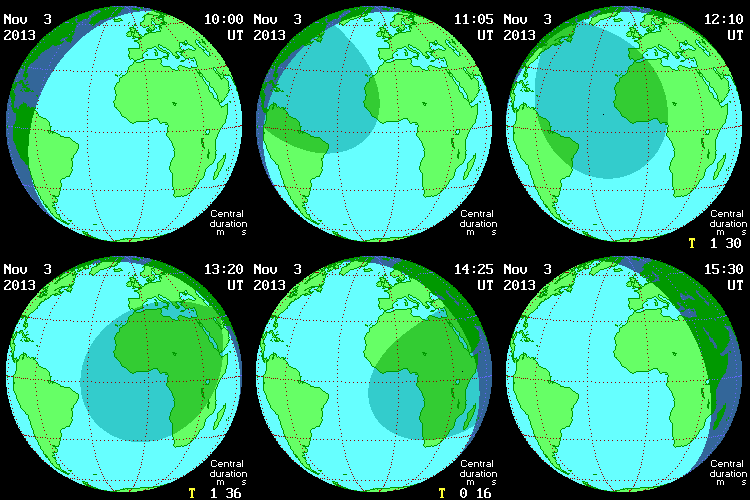
A total solar eclipse will occur on November 3, 2013. It is a hybrid eclipse (A hybrid eclipse (also called annular/total eclipse) shifts between a total and annular eclipse. At certain points on the surface of Earth it appears as a total eclipse, whereas at other points it appears as annular. Hybrid eclipses are comparatively rare) of the Sun.

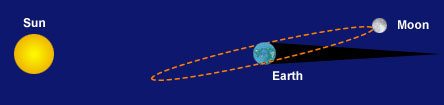
This final eclipse of 2013 is the most interesting eclipse of the year. It is one of the rare hybrid or annular/total eclipses in which some sections of the path are annular while other parts are total. The duality comes about when the vertex of the Moon's umbral shadow falls on Earth's surface at some locations, but falls short of the Earth along other sections of the path. The unusual geometry is due to the curvature of Earth's surface that brings some geographic locations into the umbra while other positions are more distant and enter the antumbral rather than umbral shadow. In most cases, the central path begins annular, changes to total for the middle portion of the track, and reverts back to annular towards the end of the path.

However, November 3 eclipse is even more unique because the central path begins annular and ends total. Because hybrid eclipses occur near the vertex of the Moon's umbral/antumbral shadows, the central path is typically quite narrow.

The hybrid eclipse of 2013 is visible from within a thin corridor, which traverses the North Atlantic and equatorial Africa. A partial eclipse is seen within the much broader path of the Moon's penumbral shadow, which includes eastern North America, northern South America, southern Europe, the Middle East and Africa. When the shadow leaves earth, it will be Somalia where a 1 second total eclipse occurs at sunset!!

Totality will be visible from the northern Atlantic Ocean (east of Florida) to Africa (Gabon (landfall), R. Congo, DR Congo, Uganda), with maximum of 1 minute and 39 seconds visible from the Atlantic Ocean south of Ivory Coast and Ghana. This eclipse will not be visible at all from India.

PATH OF ECLIPSE

.


ANIMATION SHOWING THE ECLIPSE


Monday, October 14, 2013

Thursday, October 10, 2013

Penumbral Lunar Eclipse

A penumbral lunar eclipse will take place on night of October 18, 2013 (October 19th 2013 early morning for india), the last of three lunar eclipses in 2013.

It will be visible from the Americas (for the end), Europe, Africa, and most of Asia (the beginning of the eclipse will be visible in east and central Asia).

In India we would be seeing the eclipsed Moonset on the 19th morning and won't be able to see the whole duration of the eclipse.

Types of Lunar Eclipses
An eclipse of the moon occurs when the earth is in a direct line between the sun and the moon. The moon does not have any light of its own; instead, it reflects the sun's light. During a lunar eclipse, the moon is in the earth's shadow. It will often look dim and sometimes copper or orange in color. The lighter part of Earth's shadow is call the "penumbra" and the totally dark part is called the "umbra". If you see a chart that says the lunar eclipse is going to be penumbral, this means that the Moon will only pass through the lighter part of Earth's shadow. A partial lunar eclipse occurs when only part of the Moon passes through the umbra, or darkest part, of Earth's shadow. A penumbral lunar eclipse occurs when moon passes through penumbra, the lighter part of the shadow

.


Why lunar eclipses don't occur every month:
Since lunar eclipses occur always at full moon, it makes sense to ask why each full moon does not generate one. Eclipses are relatively rare because the plane in which the moon orbits around Earth is tilted 5 degrees compared to the plane of Earth's travels around the sun, a plane that astronomers call the ecliptic.
To visualize, think of two hula hoops — one big and one small — floating on the surface of a pool, and push the inner one down so that half of it is below the surface and half above. When the moon gets into the ecliptic — right at the surface of the pool — during its full phase, then a lunar eclipse occurs. (The word "ecliptic" stems from the word "eclipse.")
The geometry of any eclipse — the relative positions of the sun, Earth and moon — is eventually repeated during a set of complex cycles that each last just more than 18 years. This Saros cycle, as the whole thing is called, is behind the bunching of eclipses, too. Astronomers have figured it out and can predict eclipse timing and circumstances far into future.


Timings of the Eclipse:

Penumbral Eclipse Begins: 21:50:38 UT 18th October (03:20:38 IST 19th October)
Greatest Eclipse: 23:50:17 UT 18th October (05:20:17 IST 19th October)
Penumbral Eclipse Ends: 01:49:49 UT 18th October (07:19:49 IST 19th October)

Beginning and end of a penumbral eclipse are not visible to the eye. In fact, no shading can be detected until about 2/3 of the Moon's disk is immersed in the penumbra. This would put the period of nominal eclipse visibility from about 23:30 to 00:10 UT. Keep in mind that this is only an estimate. Atmospheric conditions and the observer's visual acuity are important factors to consider. An interesting exercise is to note when penumbral shading is first and last seen.

Thursday, August 30, 2012

Occultation of 7.2 Mag star by 1497 Tampere on 22 October

Path in india of the Occultation of 7.2 Mag star by 1497 Tampere on 22  October


Monday, March 19, 2012

Occultation of 2.9 mag star by asteroid 4557 Mika


On 2012 Apr 09 23:33UT, the 20 km diameter asteroid (4557) Mika will occult a 2.9 mag star in the constellation Capricornus for observers along a path across India.

In the case of an occultation, the combined light of the asteroid and the star
will drop by 14.9 mag to 17.8 mag (the magnitude of the asteroid) for at most
0.7 seconds.
Details will be up soon.

Saturday, December 24, 2011

Lunar Occultations for Delhi in Jan 2012


Occultation prediction for DELHI India


    day  Time   P   Star  Sp  Mag  Mag    % Elon Sun  Moon   CA   PA
  m  d  h  m  s      No  D     v    r V  ill     Alt Alt Az   o    o
Jan  4 17 20 13 D     465 K2  4.4  3.8s  80+ 127     59 261  55S 111
R465 = Botein = delta Arietis
Jan  4 18 37 18 r     465 K2  4.4  3.8s  80+ 127     42 272 -68S 235
R465 = Botein = delta Arietis
Jan  5 12 42 16 D     586 K0  6.8  6.3   87+ 137  -8 47  89  90S  79
Jan  7 22 14  3 d     905cA0  6.9  6.9   98+ 163     29 280  73S 101
Jan 12 22 13  4 R    1528SA3  6.7  6.6v  85- 135     65 193  75N 312
Jan 13 19 31  4 m    1629 K0  6.6  6.1   77- 123     37 116   4S 211
Jan 14 18 37 38 r    1743wM0  6.6  5.8v  67- 110     13 104  45N 341
Jan 28 13  6  3 D      51cK0  6.8  6.1   26+  61  -9 52 244  71N  45
R51 = 45 Piscium
Jan 31 14 13 19 D     415cK1  5.8  5.2   54+  94     70 243   9S 154
R415 = 40 Arietis

Friday, December 2, 2011

Last Lunar Eclipse of 2011 - Dec. 10th


TOTAL LUNAR ECLIPSE
December 10th 2011
Year 2011 end brings us another spectacle in astronomy – Total Lunar Eclipse on 10th December! The last eclipse of the year will once again be putting a show just before the year ends and next year comes with the rarest of rare astronomical events – Venus transit. It will be visible from all of Asia and Australia, seen as rising over eastern Europe, and setting over northwest North America. In the Philippines, the lunar eclipse is seen visible just after sunset.
Eclipse Background:
What is an eclipse of the Moon? What causes eclipses and why? How often do eclipses happen and when is the next eclipse of the Moon?
We live in a world that seems so ordered; the Sun rises, goes across the sky and then sets. The Moon goes through its phases from new to full and back again. It all seems like clockwork, and then, something unusual happens that seems to throw the orderly timing of the cosmos into chaos. On a night when the moon rises full and beautiful, it starts to change; at first it is so subtle few notice it. But then, every so slowly, the moon begins to dim, and more alarming yet, it disappears.
One can only imagine how frightening the sight of a lunar eclipse must have been for our ancestors. Far more than us, they were in tune with the rhythms of the cosmos, the motions of the Sun, Moon and planets were the motions these people lived by. They told time by the daily passing of the Sun, or full moon to full moon gauged longer periods of time. And the very stars marked the passing of seasons. The skies were orderly and dependable, except for when an eclipse happened. During that time, chaos reigned, and our ancestors prayed and begged for the Moon to be returned to the sky.
Eclipse Myths:
Myths die hard. In Japan, some people still cover wells to avoid being poisoned by the disease of the moon during an eclipse. Native residents of Arctic regions are known to turn over their utensils to avoid contamination. In other cultures, people yell at the moon during an eclipse, or they bang pots or even shoot into the air. In India people take bath in holy rivers to wave off the evil effect of the eclipse.
Historical aspects:
Primitive ideas about the figure of the Earth, still found in young children, hold the Earth to be flat and the heavens a physical dome spanning over it. Lunar eclipses, e.g., always have a circular edge of appox. three times the radius of the lunar disc; as these always happen when the Earth is between Sun and Moon, it suggests that the object casting the shadow is the Earth and must be spherical (and four times the size of the Moon, the lunar and solar discs being the same size).
Our ancestors saw eclipses as evil omens, often as portents of some catastrophic event or a sign from their deities. The earliest recorded eclipse was in China on October 22, 2134 BC.  The two court astrologers to the Emporer lost their heads because; they had failed to predict it. The Babylonians were the first to calculate the regular intervals at which eclipses occur. Thales of Miletus predicted a solar eclipse that marked the beginning of the Greek scientific/philosophic era. Word eclipse comes from a Greek word, “ekleipsis” meaning abandonment.
When the moon disappeared in 413 B.C., Athenians saw it as a bad omen and delayed their planned retreat from the Sicilian city of Syracuse, where they had fought for two years in the Peloponnesian War. The Syracusans used the delay as an opportunity to break the siege, contributing — some believe — to the fall of Greek civilization.
Christopher Columbus actually used an eclipse knowingly to perhaps alter history. Stranded in Jamaica in 1504, on his fourth voyage, Columbus and his crew were wearing out their welcome with the natives, who were feeding them. Columbus knew a lunar eclipse was coming, so he "predicted" the moon’s disappearance. The natives begged him to bring it back and, of course, he did, in due time.
Types of Lunar Eclipses
An eclipse of the moon occurs when the earth is in a direct line between the sun and the moon. The moon does not have any light of its own; instead, it reflects the sun's light. During a lunar eclipse, the moon is in the earth's shadow. It will often look dim and sometimes copper or orange in color. The lighter part of Earth's shadow is call the "penumbra" and the totally dark part is called the "umbra". If you see a chart that says the lunar eclipse is going to be penumbral, this means that the Moon will only pass through the lighter part of Earth's shadow. A partial lunar eclipse occurs when only part of the Moon passes through the umbra, or darkest part, of Earth's shadow. A penumbral lunar eclipse occurs when moon passes through penumbra, the lighter part of the shadow
  
Why lunar eclipses don't occur every month:
Since lunar eclipses occur always at full moon, it makes sense to ask why each full moon does not generate one. Eclipses are relatively rare because the plane in which the moon orbits around Earth is tilted 5 degrees compared to the plane of Earth's travels around the sun, a plane that astronomers call the ecliptic.
To visualize, think of two hula hoops — one big and one small — floating on the surface of a pool, and push the inner one down so that half of it is below the surface and half above. When the moon gets into the ecliptic — right at the surface of the pool — during its full phase, then a lunar eclipse occurs. (The word "ecliptic" stems from the word "eclipse.")
The geometry of any eclipse — the relative positions of the sun, Earth and moon — is eventually repeated during a set of complex cycles that each last just more than 18 years. This Saros cycle, as the whole thing is called, is behind the bunching of eclipses, too. Astronomers have figured it out and can predict eclipse timing and circumstances far into future.


CIRCUMSTANCES OF THE ECLIPSE
Universal Time
Indian Standard Time
Moon enters penumbra
Moon enters umbra
Moon enters totality
Middle of the eclipse #
Moon leaves totality
Moon leaves umbra
Moon leaves penumbra
11h 31.8m
12h 45.4 m
14h 05.7m
14h 31.8m
14h 58.0m
16h 18.3m
17h 31.7m
17h 01.8m
18h 15.4 m
19h 35.7m
20h 01.8m
20h 28.0m
21h 48.3m
23h 01.7m

Moon will rise in eclipse in delhi
Visibility of the Eclipse


Key to Eclipse Visibility Map
P1  Penumbral eclipse begins (not visible to the eye)
U1  Partial eclipse begins
U2  Total eclipse begins
U3  Total eclipse ends
U4  Partial eclipse ends
P4  Penumbral eclipse ends (not visible to the eye)
Area of visibility: The eclipse will be visible in the region covering Africa, Europe, the Middle East, Asia, Australia, North America, Greenland, and the Indian, Pacific, and Artic Ocean. The places from where the beginning of the umbral phase is visible at the time of moonset are parts of Mexico, eastern U.S.A., eastern Canada and Greeland. The places from where the ending of the umbral phase is visible at the time of moonrise are parts of Europe, Africa and some regions of Southern Ocean.